Posted and Ignored: The Uncomfortable Truth About What No Trespassing Signs Actually Do
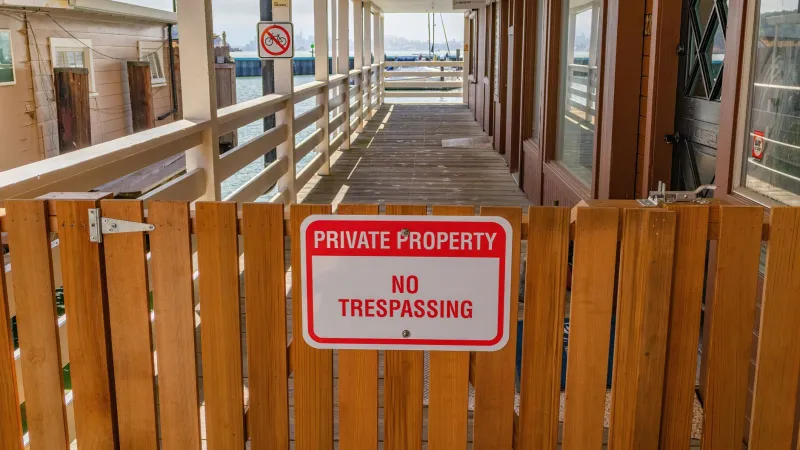
Walk through nearly any rural county in America and you will see them nailed to fence posts, bolted to tree trunks, and staked along roadsides — the familiar orange and black rectangle declaring that entry is forbidden. "No Trespassing" signs have become so culturally embedded in the American landscape that most property owners treat them as self-evidently powerful legal instruments. Buy the sign, post the sign, problem solved.
Except the problem frequently is not solved. In courtrooms, insurance disputes, and law enforcement encounters across the country, these signs are regularly found to provide far less legal protection than their owners anticipated. For a community built around knowing your boundaries and protecting your property, the gap between what homeowners believe these postings accomplish and what they actually accomplish deserves serious examination.
What a Sign Is — and Is Not
At its most fundamental level, a "No Trespassing" sign is a communication device. It conveys notice — the legal concept that a person was informed of a restriction before they acted. In the context of trespass law, notice matters enormously because most trespass statutes in the United States require that a violator either knew, or reasonably should have known, that their entry was unwelcome.
This is where property owners begin to misunderstand the sign's function. Posting a notice establishes that you communicated a prohibition. It does not, by itself, erect a legal barrier, guarantee prosecution, or insulate you from civil liability in all circumstances. The sign is evidence of notice — nothing more, and in some scenarios, considerably less than that.
The State-by-State Problem
One of the most consequential misunderstandings about trespass law is the assumption that it operates uniformly across the country. It does not. Trespass statutes are creatures of state law, and the requirements for what constitutes adequate notice vary substantially from one jurisdiction to another.
In Texas, for instance, landowners have historically been required to post purple paint markings on trees or fence posts — a specific stripe of a defined width and height — in addition to, or in some cases instead of, physical signs. A standard retail sign purchased at a hardware store may not satisfy Texas's statutory notice requirements in certain rural contexts. Similar "purple paint laws" exist in Arkansas, Illinois, Kansas, Missouri, North Carolina, and several other states, each with its own dimensional specifications.
Other states impose requirements about sign spacing along a property boundary. Some jurisdictions require postings at every corner, at defined intervals, or at all points of public access. A single sign at the driveway entrance of a large rural parcel may satisfy notice requirements for individuals who enter via that driveway while providing no legal notice whatsoever to someone who crosses from an adjoining property line two hundred yards away.
Property owners who purchase land across state lines, or who simply assume that federal standards govern, are particularly vulnerable to these jurisdictional gaps.
When Signs Fail in Civil Liability Contexts
Perhaps the most financially dangerous misunderstanding involves premises liability — the body of civil law governing when a property owner can be held responsible for injuries suffered by individuals on their land.
The presence of a "No Trespassing" sign does not categorically eliminate civil liability for injuries that occur on your property. Courts in many states distinguish between different categories of entrants: invitees, licensees, and trespassers. While property owners generally owe the lowest duty of care to trespassers, that duty is not zero, and it is subject to significant exceptions.
The most prominent exception involves children. The "attractive nuisance" doctrine, recognized in varying forms across most of the United States, holds that property owners may be liable for injuries to child trespassers when the property contains a hazardous condition that children are likely to be drawn toward — a swimming pool, an abandoned structure, construction equipment, or a pond, among many examples. Courts have repeatedly held that a "No Trespassing" sign does not neutralize an attractive nuisance, because children of a certain age cannot be expected to comprehend or meaningfully respond to written warnings.
Additionally, some states impose heightened duties on landowners who are aware that trespassers habitually cross their land. If your property is a known shortcut and you have observed foot traffic for years without taking action beyond posting a sign, a court may find that your awareness of the ongoing trespass created an obligation to do more.
The Criminal Enforcement Reality
Many homeowners post signs with the expectation that law enforcement will treat any violation as a prosecutable criminal offense. The reality of how trespass complaints are handled varies dramatically by jurisdiction, and property owners are often disappointed to discover that local law enforcement agencies exercise considerable discretion in responding to trespass calls.
In suburban and urban environments, officers frequently treat trespass incidents as civil matters unless there is evidence of criminal intent, damage, or a threat to safety. A sign alone, without additional documentation of the violation, can make it difficult to pursue even a misdemeanor trespass charge. Prosecutors weighing limited resources may decline to file charges based solely on a property owner's assertion that a sign was posted.
This is not an argument against posting signs — it is an argument for understanding that the sign initiates a process rather than completing one.
What Actually Strengthens Your Legal Position
Given these limitations, what should a property owner who is serious about boundary protection actually do?
First, research your state's specific statutory requirements for trespass notice. Many state agriculture departments, bar associations, and county extension offices publish accessible guidance on this topic. Compliance with the letter of your state's law is the foundation upon which everything else rests.
Second, document your postings. Photograph your signs at the time of installation, including date-stamped images that show their placement relative to the property boundary. Maintain records of when signs were installed, replaced, or supplemented. This documentation becomes critical if you ever need to demonstrate that notice was properly given at the time of an incident.
Third, consider physical boundary reinforcement. Fencing, whether as a primary barrier or as a mounting structure for signage, communicates a boundary in a way that is difficult to dispute and that courts tend to view as unambiguous notice. A fence does not merely post a warning — it instantiates the boundary in the physical world.
Fourth, consult a local real estate attorney if you are dealing with a recurring trespass issue or a specific liability concern. The cost of a single consultation is modest relative to the potential exposure from a premises liability claim.
The Broader Lesson About Symbolic Protection
The "No Trespassing" sign endures in American culture because it satisfies a deep desire for simple, visible solutions to complex legal problems. It is inexpensive, immediate, and legible. It communicates intent clearly to people of good faith.
But property rights are not protected by symbols alone. They are protected by documented compliance with state law, by physical demarcation of boundaries, by consistent enforcement, and by the kind of informed awareness that distinguishes a property owner who has genuinely secured their land from one who has merely posted a warning and hoped for the best.
Knowing your boundaries means understanding not just where your property ends, but what the law actually requires to defend it.