Beneath Your Feet: The Hidden Web of Utility Easements That May Limit What You Can Do With Your Own Land
You paid for every inch of your property. You hold the deed. You pay the taxes. Yet somewhere below the surface of your backyard — and possibly running beneath your driveway, your garden, or the foundation you just poured — a utility company may hold a legal right that supersedes your own. This is not a theoretical concern. It is a daily reality for tens of millions of American landowners, and it is a reality that most of them never encounter until it is far too late.
Utility easements are among the least-discussed dimensions of American property law, yet they are also among the most consequential. As infrastructure ages across the country and utility companies embark on large-scale upgrade projects, the friction between corporate easement rights and individual property ownership is intensifying. Homeowners who once assumed their land was fully their own are discovering otherwise — sometimes when a work crew arrives with excavation equipment and minimal advance notice.
What a Utility Easement Actually Is
An easement is a legal right granted to a party — whether a corporation, a government entity, or a private individual — to use a portion of someone else's land for a specific purpose. Utility easements grant electric, natural gas, water, sewer, and telecommunications companies the right to install, access, maintain, and upgrade infrastructure that runs through or beneath private property.
These rights are typically established in one of three ways: through language embedded in the original deed when a property was first subdivided, through a separately recorded easement document filed with the county, or through what is known as a prescriptive easement — a legally recognized right that can develop when a utility company has used a corridor of land openly and continuously for a statutory period, often without the owner's explicit consent.
The scope of what these easements permit is broader than most homeowners assume. Depending on the language of the recorded document, a utility company may have the right to enter your property without prior notice in an emergency, trim or remove trees that interfere with overhead or underground lines, prohibit permanent structures within the easement corridor, and conduct excavation work that temporarily disrupts landscaping or surface improvements — with limited or no obligation to restore those features to their original condition.
Why Most Homeowners Never See This Coming
The discovery process for utility easements is theoretically straightforward. They are recorded public documents, accessible through county recorder or register of deeds offices. A title search conducted during a real estate transaction should, in principle, surface these encumbrances. In practice, however, the disclosure of utility easements is often perfunctory. A title commitment may list them in a schedule of exceptions without any plain-language explanation of what those easements actually permit.
Buyers — particularly first-time homeowners — frequently sign closing documents without understanding that a gas distribution easement running through the rear of their lot prohibits the construction of any permanent structure in that zone. Real estate agents are not always equipped to interpret easement language, and attorneys are not always involved in residential closings in every state.
The result is a vast population of property owners who are legally bound by restrictions they were never meaningfully informed of.
The Upgrade Problem
For decades, many utility easements lay dormant. Infrastructure was installed, it functioned, and utility companies had little reason to disturb the land above it. That era of relative quiet is ending.
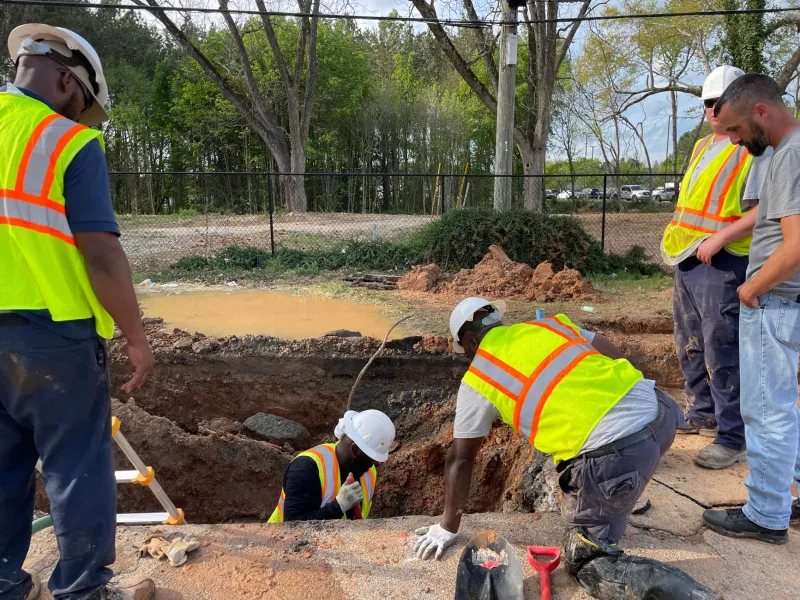
Across the United States, aging electrical grids, deteriorating water mains, and the rapid expansion of fiber-optic telecommunications networks are driving unprecedented levels of underground utility work. Utility companies are exercising easement rights that have existed on paper for generations but were rarely acted upon. And they are doing so in ways that property owners find jarring.
In a number of documented cases, homeowners have returned from work to find trenches dug through mature landscaping, ornamental trees felled, or irrigation systems severed — all within easement corridors where the utility company had every legal right to operate. Compensation for these disruptions is frequently limited or nonexistent. The easement language, when examined, often explicitly disclaims any obligation to restore the property to its prior condition.
The legal standard in most jurisdictions is that a utility company must exercise its easement rights in a manner that is reasonably necessary for its stated purpose. It must avoid unnecessary damage. But "unnecessary" is a word that courts have interpreted narrowly in favor of utility companies, particularly when the work in question involves legitimate infrastructure maintenance or mandated safety upgrades.
How to Discover What Is Recorded Against Your Property
Every homeowner should take the time to understand the easements that encumber their land. The process requires some effort but is entirely accessible without legal training.
Begin with your title insurance policy, if one was issued at closing. The schedule of exceptions will list recorded easements by document number. You can then request copies of those documents from your county recorder's office, either in person or, increasingly, through online public records portals. Read the easement language carefully, paying particular attention to the width of the easement corridor, the types of utilities it covers, and any provisions governing restoration after work is performed.
For properties with complex histories, or where the easement documents are ambiguous, consulting a real estate attorney for a focused review is a reasonable investment. Separately, your local utility companies can often tell you where their infrastructure runs through your property — and many now offer online mapping tools that provide approximate corridor locations, though these should not be treated as legally precise.
Before undertaking any construction, landscaping, or excavation project, call 811 — the national "Call Before You Dig" service — to have underground utilities marked. This is both a legal requirement in most states and a practical safeguard against costly or dangerous encounters with buried infrastructure.
When Your Plans Conflict With Their Rights
Homeowners who discover that a planned project falls within a utility easement corridor have limited but meaningful options. In some cases, the utility company may consent to a modification or a variance, particularly if the proposed structure would not materially interfere with access or infrastructure integrity. This consent should always be obtained in writing.
In other cases, a homeowner may petition to have an easement vacated or relocated — a legal process that typically requires demonstrating that the easement is no longer necessary for its stated purpose, or that an alternative corridor would serve the utility's needs equally well. This process is rarely simple, and success is not guaranteed.
What homeowners should avoid is proceeding with a project in the hope that the easement will never be enforced. Utility companies are under increasing regulatory pressure to maintain and upgrade their infrastructure, and the legal exposure for a homeowner who has constructed a permanent structure within an easement corridor — only to have it removed by court order — can be severe.
The Boundary You Cannot See
FenceOff exists to help property owners understand every dimension of the boundaries that define and limit their land. Utility easements represent a boundary that is invisible to the eye but fully enforceable in law. They run beneath driveways, through backyards, and along fence lines across virtually every developed property in the United States.
Knowing where they are, what they permit, and how they may affect your plans is not a legal luxury. It is a fundamental act of responsible property ownership. The ground beneath your feet may belong to you — but the rights to what lies within it may be shared in ways you have not yet reckoned with.